Wondering when a high-priced property pushes your mortgage out of the conventional range and into jumbo territory? Understanding jumbo loan limits is essential for buyers purchasing higher-priced homes, as these limits determine when specialized financing is required.
Elite Lending Service, led by Brad Bailey, helps Jacksonville and North Florida buyers understand how a mortgage amount can cross the conforming threshold and change underwriting, rate, and interest expectations.
This short guide explains the 2025 baseline—$806,500 for most one‑unit homes—and notes the higher ceiling used in select high‑cost areas. You’ll learn what changes when you exceed conforming loan limits, what lenders typically expect for credit, down payment, and reserves, and how those factors affect monthly payments.
Brad’s team provides personalized guidance so you can compare product options, estimate costs, and prepare a strong application. For local, trusted support, call (904) 263-0376 or email brad@elitelendingservice.com.
Key Takeaways
- Learn when a mortgage becomes a jumbo loan and why that matters for approval.
- Understand the 2025 baseline and why Jacksonville is not a high‑cost area.
- See how rate, interest, and points influence monthly payment and affordability.
- Know typical lender expectations for credit, down payment, and reserves.
- Use local expertise from Elite Lending Service to match loans to your home goals.
What a Jumbo Loan Is and Why It Matters in North Florida
High-priced homes in North Florida can push your mortgage past standard agency underwriting, changing how you qualify and what you pay.
A jumbo loan is simply financing used when a mortgage exceeds the FHFA conforming ceiling. For 2025 that baseline is $806,500 for most one-unit homes. When your desired loan amount goes above that number, conventional agency programs no longer buy the note.
Jumbo vs. conforming: how mortgages exceed the FHFA limit
Conforming loan programs follow standard underwriting set by Fannie Mae and Freddie Mac. When a mortgage exceeds those published county limits, lenders create custom products with stricter credit, reserve, and documentation rules.
When you might need a jumbo loan for your home purchase
You may need this product if your purchase price minus down payment pushes your loan amount past the county cap. Common scenarios include a larger primary residence, a coastal second home, or higher‑valued properties in growing North Florida neighborhoods.
- Stricter underwriting and deeper documentation
- Different pricing and possible higher interest rate
- Options for primary, second, and investment properties
Elite Lending Service helps borrowers weigh choices—can you increase down payment or lower price to stay conforming, or is a jumbo solution the better path? Their team guides you through paperwork, timelines, and product selection so you can plan closing and payments with confidence.
Current jumbo loan limits and how they’re set
Each year, federal housing finance agencies publish county‑by‑county conforming loan limits to reflect market changes. For 2025 the baseline conforming loan limit for a one‑unit property is $806,500 in most counties.

Designated high‑cost areas can have higher maximums — up to $1,209,750 for a one‑unit home in 2025. Jacksonville (Duval County) is not a high‑cost area, so buyers here follow the baseline.
Looking ahead and checking county figures
Proposed 2026 baselines show a 1‑unit cap near $832,750 and larger numbers for multi‑unit properties. These adjustments can change whether your mortgage fits agency programs or requires a custom product.
- The FHFA updates conforming loan limits each year for each county.
- Crossing the local conforming loan limit moves your scenario into non‑agency underwriting.
- Elite Lending Service monitors annual county updates so you have current numbers before you write offers.
Check the published county figures early—if your target amount is close to the ceiling, a small change in price or down payment can determine whether you stay within the conforming loan limits or move to an alternative path. Brad Bailey helps clients interpret the applicable year and optimize their financing strategy.
When a government-backed option may outperform a conventional choice
FHA can help buyers with modest credit. It allows lower scores with 3.5% down at 580+ or 10% down for 500–579. Mortgage insurance rules differ from private mortgage insurance and can affect long-term cost.
Jumbo loan limits in Jacksonville: what buyers should know now
When the amount you need to borrow surpasses Duval’s published baseline, your financing path may shift to non‑agency products. In 2025 the one‑unit conforming loan limit for Jacksonville is $806,500. Exceeding that figure changes underwriting, documentation, and pricing.
What “exceeds the conforming loan limit” means for Duval and surrounding counties
In simple terms, “exceeds the conforming loan limit” means your required loan amount is above the one‑unit baseline. That triggers different programs with stricter credit, reserves, and paperwork. Elite Lending Service reviews Duval, St. Johns, Clay, and Nassau county figures to determine whether your scenario stays within conforming or moves to an alternative product.
Single-family vs. 2-4 unit properties: limits and implications
Multi‑unit properties have higher published baselines proposed for 2026: 2‑unit $1,066,250; 3‑unit $1,288,800; 4‑unit $1,601,750. Those higher thresholds can keep some purchases conforming even at higher prices.
- If your price is close to the ceiling, a larger down payment can keep your loan amount conforming.
- New construction, coastal properties, or neighborhood premiums often push totals higher—get pre‑approval early.
- Elite Lending Service maps county rules to your property type so you know whether conforming or jumbo financing is the best path.
Jumbo loan requirements buyers should prepare for
Preparing for higher‑value financing starts with knowing the documentation and credit standards lenders expect.
Credit score expectations and income documentation
Strong credit helps your application stand out. Many programs favor a credit score above 700, though exact thresholds vary by lender.
Income must be clearly documented with W‑2s, recent pay stubs, tax returns, and year‑to‑date statements. Self‑employed borrowers should provide additional verification.
DTI, cash reserves, and closing considerations
Underwriters typically look for a debt‑to‑income ratio near or below 43% to show you can handle higher monthly payment obligations.
Cash reserves—expressed in months of principal and interest—are common and depend on property use and occupancy. Also budget for appraisal, title, escrow, and closing costs, which grow with the loan amount.
Down payment ranges and influencing factors
Expect down payments between 10% and 30%, influenced by credit, property type, and total loan size. Many programs do not require mortgage insurance when minimum down payment rules are met.
- Elite Lending Service compares multiple lender guidelines to position your file for approval.
- Brad Bailey puts you first—matching your profile to the ideal program and explaining every step to closing.
Jumbo mortgage interest rates: how they’re priced
Interest pricing blends market moves with your file details. The stated rate is the base interest charged. APR shows the annual cost including some fees and points. That difference helps you compare offers fairly.
Rate vs. APR, points, and monthly payment
Paying points reduces the rate and can lower your monthly payment. One point equals 1% of the loan amount. The breakeven depends on how long you keep the mortgage.
Market conditions, LTV, and property impacts on rate
Market rates shift with the economy. A higher credit score and lower loan‑to‑value usually secure better pricing. Occupancy and property type also influence a lender’s pricing and overlays.
- ARMs tied to SOFR adjust after an initial fixed period; caps limit changes but payments may vary.
- Fixed rates give stability; adjustable options can lower early payments.
- Elite Lending Service compares scenarios so you balance short‑term payment comfort with long‑term savings.
Eligible property types and occupancy for jumbo mortgages
Which type of property you buy — and how you occupy it — changes eligibility and pricing for large mortgages. Elite Lending Service helps you compare options across Jacksonville and North Florida so you know which path fits your goals.
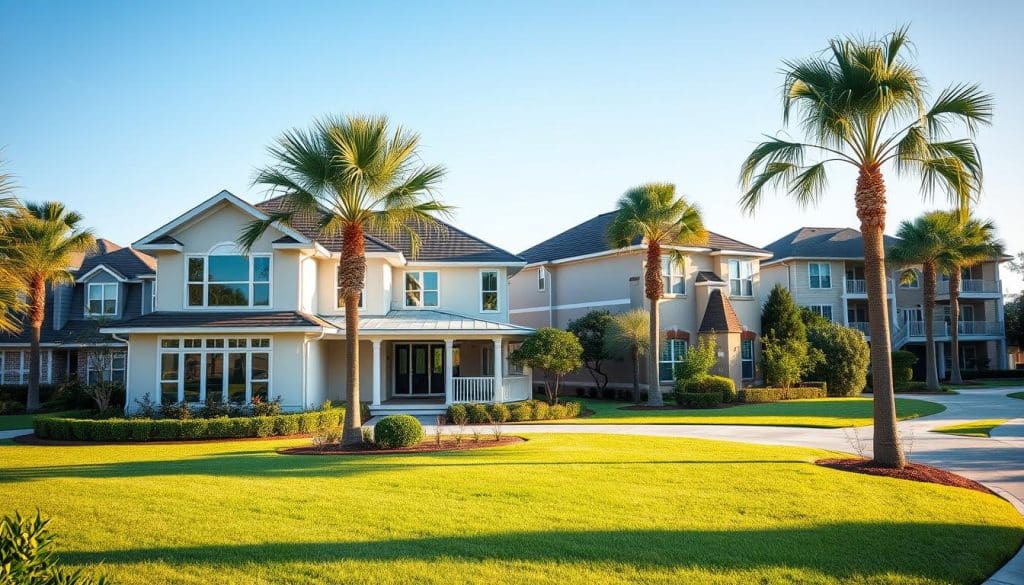
Primary residences generally receive the most favorable terms. Lenders favor owner-occupied homes with stronger pricing, lower interest, and easier underwriting compared with other uses.
Second homes and vacation properties are eligible under many jumbo loans, especially in coastal or resort-adjacent areas. Expect slightly tighter documentation and sometimes higher rates than for a primary home.
- Most programs finance 1–4 unit primary residences; second‑home options exist for desirable markets.
- Investment properties qualify, but underwriters require higher reserves and stricter credit standards.
- Occupancy and unit count directly affect pricing, documentation, and qualification rules.
Elite Lending Service reviews property condition, location, and marketability to align your financing with the correct eligibility rules. If you’re weighing second-home versus rental use, the team will model both scenarios so you see the impact on qualifying, payments, and long-term cost.
How jumbo loan limits affect your budget, payments, and approval
Small shifts in price or down payment change the amount you must borrow. That single change can determine whether your mortgage stays within a conforming loan or requires a jumbo product.
Loan amount, price, and the path from conforming to jumbo
Your target price minus the down payment sets the required loan. If that amount exceeds the published county limits, underwriting becomes stricter and approval may take longer.
Elite Lending Service models scenarios so you can see whether a slightly larger down payment keeps you in a conforming loan. They also show costs if moving to jumbo loans and help you decide the best path.
Monthly payments, adjustable-rate options, and payment changes
Mortgage payments usually start with principal and interest; taxes and insurance increase the actual payment. Elite Lending Service compares fixed and ARM options to show trade‑offs in monthly payments and total interest paid.
- Your borrowed amount drives the base payment and the interest rate you’ll receive.
- Adjustable rates can lower initial payment but may change after the initial period; Elite models best‑ and worst‑case outcomes tied to SOFR caps.
- If staying within conforming is important, small price or down payment changes often save on payment and long‑term cost.
Getting started in Jacksonville with Elite Lending Service
Take the first step with a fast, plain‑spoken pre-approval that clarifies price, down payment, and documentation needs.
Elite Lending Service, led by Brad Bailey, pairs two decades of experience with a client‑first process. The team helps you compare interest rate versus APR, points, and lock options so you make an informed choice.
Local guidance for pre-approval, rate shopping, and locking
Start with a local pre-approval that shows whether your scenario fits within published loan limits or requires a higher-value product.
Work with Brad Bailey: matching you to the right jumbo product
Brad compares offers across multiple lenders and explains how credit, income, and credit score affect pricing and approval. If you target a jumbo loan or a jumbo mortgage, he tailors documentation and reserve plans to strengthen your file.
Contact Elite Lending Service
- Call: (904) 263-0376
- Email: brad@elitelendingservice.com
- Serving Jacksonville, North Florida, and surrounding areas
Elite Lending Service supports you from first conversation to closing—rate shopping, locking, and milestone management so you move forward with confidence.

Conclusion
Smart preparation — from credit checks to choosing fixed or adjustable rate options — protects your timeline and budget.
In 2025 the baseline conforming one‑unit figure is $806,500, and high‑cost areas can reach $1,209,750. Proposed 2026 numbers rise modestly, so plan now if your mortgage exceeds a local ceiling.
If your target crosses the county cap, expect stricter underwriting, larger down payments, and different pricing. Elite Lending Service, led by Brad Bailey, matches your profile to the right program and explains payment tradeoffs clearly.
Ready to compare options and confirm requirements? Call (904) 263-0376 or email brad@elitelendingservice.com for personalized guidance.
FAQ
What is a jumbo mortgage and why does it matter for North Florida buyers?
A jumbo mortgage is a home financing product for amounts that exceed the Federal Housing Finance Agency’s conforming cap. In North Florida, it matters because higher-priced properties or multi-unit homes often surpass the standard cap, requiring different underwriting, higher down payment, and more documentation than a conforming mortgage.
How does a mortgage exceed the FHFA conforming loan limit?
A mortgage exceeds the conforming limit when the requested amount is larger than the regional cap set by the FHFA. When that happens, the loan falls outside Fannie Mae and Freddie Mac guidelines and lenders apply stricter credit, reserve, and down payment standards.
When might I need this type of mortgage for a home purchase in Jacksonville?
You may need this product if the purchase price for a single-family home, a 2–4 unit property, or a luxury property is above the local conforming cap. Common reasons include buying in a desirable neighborhood, purchasing a larger home, or acquiring an investment property that pushes the price beyond the limit.
What was the baseline conforming loan limit for 2025?
The baseline conforming cap for 2025 for most areas was $806,500 for a one-unit property. Loans above that amount typically require non-conforming underwriting.
Are there higher caps for high-cost areas and does Jacksonville qualify?
High-cost area caps can reach up to $1,209,750 for a one-unit property. Jacksonville is generally not designated a high-cost area, so most buyers follow the standard baseline cap for eligibility and pricing decisions.
How do county-by-county limits work and where can I check them?
Limits vary by county when a county qualifies as high-cost or unique market. The FHFA posts official county limits on its website and lenders like Elite Lending Service can confirm the applicable cap for Duval and neighboring counties during pre-approval.
What does “exceeds the conforming loan limit” mean for Duval County buyers?
For Duval County, it means any mortgage amount above the FHFA’s listed cap for the county will be considered non-conforming. Borrowers will face different underwriting criteria, possibly higher interest rates, and larger down payment expectations.
How do limits differ between single-family homes and 2–4 unit properties?
Conforming caps are higher for multi-unit properties than for single-family homes. As unit count rises, eligible conforming amounts increase; once the requested amount exceeds the applicable cap for that unit count, non-conforming underwriting applies.
What credit score and documentation should buyers prepare for non-conforming mortgages?
Lenders typically expect higher credit scores for non-conforming cases—often mid-700s or better—and comprehensive income documentation. This includes pay stubs, W-2s, tax returns, and asset verification to demonstrate repayment ability.
What changes are being proposed for 2026 limits?
Proposed baseline adjustments for 2026 could raise the one-unit conforming cap (for example, around 2,750 in some proposals). Exact numbers depend on FHFA announcements, so buyers should check updated figures before locking rates..
How do debt-to-income ratio, reserves, and closing costs factor into approval?
Lenders review DTI closely; lower ratios improve approval odds. They also require more cash reserves—often several months of mortgage payments—and full closing cost funds. Strong reserves and low DTI can offset borderline credit or higher loan amounts.
What down payment should buyers expect?
Down payments for non-conforming mortgages typically range from about 10% to 30%, depending on credit, property type, and loan program. Higher down payments reduce lender risk and can secure better rates and terms.
How are interest rates priced for non-conforming mortgages?
Rates reflect market conditions, the loan-to-value ratio, credit profile, and property type. Lenders price in additional risk for non-conforming amounts, so borrowers with strong profiles and larger down payments typically receive more competitive pricing.
What’s the difference between rate and APR, and how do points affect monthly payment?
The rate is the interest charged on the loan; APR includes the rate plus fees and points spread over the loan term. Paying points lowers the interest rate and monthly payment but increases upfront costs, so buyers should compare scenarios to find the best net cost.
How do market conditions, LTV, and property type change the offered rate?
In rising-rate markets or for higher LTVs, lenders charge higher rates to offset risk. Investment properties and multi-unit homes also command higher pricing than owner-occupied single-family residences.
Which property types and occupancies are eligible?
Eligible properties commonly include primary residences, second homes, and investment properties. Each occupancy type carries different underwriting standards and reserve requirements, with investment properties usually requiring the strictest terms.
How does moving from a conforming amount to a non-conforming amount affect my budget?
Crossing the conforming threshold can increase required down payment, raise interest rates, and lengthen documentation. These changes affect monthly payment and cash needed at closing, so buyers should model payments under both scenarios to budget accurately.
What are common monthly payment and adjustable-rate considerations?
Monthly payments depend on rate, loan term, and down payment. Adjustable-rate options can start with lower payments but carry future rate risk. Buyers should weigh short-term savings against long-term affordability and potential payment increases.
How can Elite Lending Service help Jacksonville buyers get started?
Elite Lending Service offers local guidance on pre-approval, rate comparisons, and locking strategies. The team helps you gather documentation, estimate payments, and choose the product that matches your goals and risk tolerance.
How do I contact Elite Lending Service for personalized assistance?
Call (904) 263-0376 or email brad@elitelendingservice.com to schedule a consultation. The team serves Jacksonville, North Florida, and surrounding areas and will guide you through pre-approval and next steps.
Who will I work with at Elite Lending Service?
You’ll work directly with an expert loan officer who provides local market knowledge and personalized recommendations to match your financial profile with the right mortgage product.